9 Best DIY Home Security Systems With Smartphone Control (November 2026)
The best DIY home security systems with smartphone control include the tolviviov 15-Piece WiFi Home Security System (best overall), the PGST Home Security Systems 12-Piece Kit for unreliable WiFi, and the D1D9 24pcs Wireless DIY Home Burglar Alarm for large homes and small offices.
On this page (5 sections)
- The best DIY home security systems with smartphone control
- How these smartphone-controlled kits compare
- How we compared these DIY home security systems with smartphone control
- What should you check before buying a phone-controlled kit?
- Which DIY home security system with smartphone control should you buy?
The best DIY home security system with smartphone control for most homes is the tolviviov 15-Piece WiFi Kit, because it covers 10 doors out of the box and pushes real-time alerts to the app without a monthly fee. Pick the PGST 12-Piece Kit if your WiFi is unreliable, since it switches to 4G on its own and keeps the alerts coming.
Smartphone control is what separates these kits from a plain siren. You arm the house from the app on the way out, and the hub pushes a notification when a door opens while you're at work.
That single feature is why the hub's connectivity matters more than the number of pieces in the box.
Our score weighs specs, features and buyer feedback against what you're shopping for in a phone-controlled kit. Every kit below is wireless and self-installed, so you won't need a drill for most of the sensors.
Our picks at a glance
-
1

-
2

-
3
 Best for large homes and small offices
D1D9 24pcs Wireless DIY Home Burglar Alarm
9.2/10 our score
See it on Amazon
- 4
 Check it
TUGARD Alarm System with Phone APP Alert
Best for app alerts without a smartphone habit - 5
 Check it
Ring Alarm 8-Piece Kit (2nd Gen)
Best for Alexa households - 6
 Check it
YISEELE Home Security System Wireless
Best for renters - 7
 Best for whole-house Ring coverageCheck it
- 8
 Check it
Hapippofa GEN 2 Wireless Home Security System
Best for touchscreen control - 9
 Check it
SimpliSafe 11-Piece System with Camera
Best for camera coverage
The best DIY home security systems with smartphone control
The tolviviov kit wins on coverage and fee-free app alerts, and each kit below is the best fit for a different home or a different phone habit. Choose by your WiFi reliability, how many doors you need watched and whether you want a camera in the app.
tolviviov 15-Piece WiFi Home Security System: Best overall
- 15-piece kit with 10 door sensors
- App, remote and Alexa control
- 120 dB siren
- No monthly fee
Ten door sensors and a motion detector cover more entry points than most kits here, and the app arms, disarms and alerts without a subscription.
Pros
- 10 door/window sensors in the box
- App alerts with no monthly fee
- Expands to 20 sensors and 5 remotes or keypads
Cons
- 2.4GHz WiFi only
- Battery powered with no cellular fallback
tolviviov suits a full house with several exterior doors. The box holds 10 door/window sensors and 1 motion sensor, so most single-family homes can cover every entry without buying extras.
That count is what pushes it to the top: a kit with four contacts leaves your back door and garage unwatched unless you pay more later.
The app arms and disarms, sends real-time alerts when a sensor trips and works with Alexa for hands-free arming. A 120 dB siren sounds at the base station when the system triggers.
The kit also includes a keypad and two remote controls for family members who would rather not open the app at the door.
There's no monthly fee, and the hub accepts up to 20 sensors and 5 remotes or keypads if you want to grow. The base station is battery powered and rated to a 100-foot range.
One limit matters: it runs on 2.4GHz WiFi only, so a 5GHz-only router won't connect. With no cellular path, a WiFi outage also silences the app until the router is back.
The base station runs on battery, so plan where it sits within WiFi range. Pair the hub with the sensors first, then walk each door with the app open to confirm alerts land.
Buy it for whole-house coverage with free app alerts. Skip it if your WiFi drops often or your router only broadcasts on 5GHz.
PGST Home Security Systems 12-Piece Kit: Best for unreliable WiFi
- WiFi plus 4G auto-switch
- Smart Life or Tuya app control
- 110 dB siren
- Alexa voice control
The hub stays online when WiFi fails by switching to 4G, so app alerts keep arriving during an outage or a router reboot.
Pros
- Automatic 4G fallback when WiFi drops
- App control through Smart Life or Tuya
- Fits 3-5 bedroom homes
Cons
- 4G needs a SIM card and data plan
- Fewer door sensors than the top pick
PGST suits a home where the WiFi isn't dependable. The hub talks over 2.4G WiFi and 4G, and it switches to the cellular network by itself when WiFi disconnects, so app alerts keep arriving during an outage or a router reboot.
The kit is sized for 3-5 bedrooms: a base station, keypad, 4 door/window sensors, 2 motion detectors and 2 remotes. Arm modes run from the keypad, including stay, away and emergency.
Its rated range is long, so a hub placed centrally should reach sensors in most houses.
Control and notifications come through the Smart Life or Tuya app with no subscription, and Alexa voice arming works too. A 110 dB siren is a little quieter than the 120 dB units here.
The kit carries a 2-year manufacturer warranty.
You need a SIM card and a data plan to use the 4G path. Set that up before relying on the cellular fallback.
The 4 door sensors also fall short of the tolviviov kit if your house has many entries.
Buy it for a home with flaky WiFi. Skip it if you only have 5GHz WiFi and no interest in a cellular plan.
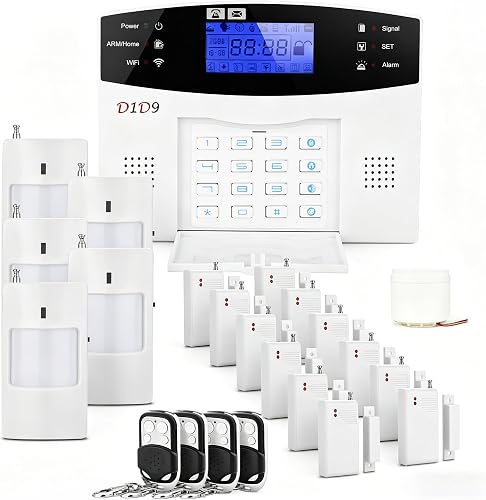
D1D9 24pcs Wireless DIY Home Burglar Alarm: Best for large homes and small offices
- 24-piece kit
- 4G and WiFi connectivity
- Peel-and-stick install
- No monthly fee
The largest kit here covers doors, windows and rooms across a big house or a small business, all armed and alerted through the app.
Pros
- 24 pieces for wide coverage
- 4G plus WiFi connectivity
- Stick-on install in about 30 minutes
Cons
- Needs a SIM card or WiFi
- Batteries are gifts and may need replacing
D1D9 suits a large house or a small business with many doors. The 24-piece kit includes door/window contacts, motion detectors, a remote and a siren, covering a spread-out floor plan in one order.
Installation is peel-and-stick, and D1D9 puts the job at about 30 minutes. Connectivity runs over 4G and WiFi, so app alerts and control work away from home.
Rated range is 80 meters, a little shorter than the PGST hub, so keep that in mind in a long building.
The kit needs a SIM card or a WiFi connection to function, so budget for one or the other. Its batteries are included as gifts and may need replacing sooner than the sensors in the other kits.
There's also a wired siren in the box, which means one cable run rather than a fully wireless install.
For a shop or a rental property with several entries, the piece count is the reason to choose it. For a compact apartment, the same kit leaves sensors spare.
Buy it for wide coverage in one box. Skip it if you want a small, tidy kit for a two-door flat.
TUGARD Alarm System with Phone APP Alert: Best for app alerts without a smartphone habit
- 2.4-inch TFT color screen
- WiFi and 2G dual network
- App push, call and SMS alerts
- RFID cards and remotes
The hub shows arm and disarm status on a color screen and calls your phone as well as pushing to the app, so alerts reach you even without opening the app.
Pros
- Push, call and SMS alerts
- Color screen shows system status
- RFID cards for quick disarming
Cons
- 2G SIM sold separately
- No 5GHz WiFi support
TUGARD suits a household where not everyone checks an app. The hub has a 2.4-inch color screen that shows arm and disarm status, and when a sensor trips it pushes to the app, calls your phone and sends an SMS to the numbers you set.
That triple alert path covers the case where a phone is on silent or the app isn't installed.
It runs on 2.4GHz WiFi with a 2G SIM as backup, so alerts can still go out when the WiFi is off. The kit has a motion detector, 4 door/window sensors, 2 remotes, 2 RFID cards and a siren.
The motion sensor goes on an interior wall, and the door contacts alarm when a door or window opens more than 2cm.
RFID cards let someone disarm with a tap instead of remembering a code. That's handy for older family members or a cleaner, and the remote has an SOS key for emergencies.
The SIM card is sold separately, and the hub doesn't support 5GHz WiFi. Check 2G coverage where you live before you rely on that fallback.
Rated range is short at 50 feet, so plan hub placement carefully.
Buy it for call and text alerts as well as app pushes. Skip it if you want a simple app-only setup.
Ring Alarm 8-Piece Kit (2nd Gen): Best for Alexa households
- 8-piece kit for 1-2 bedroom homes
- Ring app alerts and control
- Optional Ring Protect plan
- Alexa voice arming
Ring's app ties the alarm to the rest of your Ring cameras and doorbells, and Alexa can arm it by voice with a Protect plan.
Pros
- Works with Ring cameras and doorbells
- Range extender included
- Alexa voice control with a plan
Cons
- Cellular backup needs a Ring Protect plan
- Fewer sensors than the bigger Ring kit
Ring suits a home that already uses Ring cameras or a doorbell. The 8-piece kit covers 1-2 bedrooms with a base station, keypad, 4 contact sensors, a motion detector and a range extender.
The extender matters in a house where the hub sits far from the router.
Everything runs from the Ring app, where you arm, disarm and get mobile notifications alongside your other Ring devices. Alexa can arm it by voice once you have a Ring Protect plan.
The plan is also what keeps the system online when the WiFi drops. Without it, the hub is WiFi-only, which is the main trade-off against the PGST and D1D9 kits here.
Ring also sells additional sensors and accessories at any time, so the kit grows with the house.
For a small home already in the Ring ecosystem, the app integration is the reason to pick it. For a house without Ring cameras, the fee-free kits offer more sensors for the same job.
Buy it for one app across alarm and cameras. Skip it if you want cellular backup without a subscription.
YISEELE Home Security System Wireless: Best for renters
- 15-minute setup
- 120 dB siren
- Smart Life app alerts
- Rechargeable backup battery in the hub
A small stick-on kit with a hub battery that keeps the system running during a blackout, which suits apartments where wiring is off limits.
Pros
- Built-in rechargeable backup battery
- Setup in about 15 minutes
- Expands to 100 accessories
Cons
- Only 4 door/window sensors
- No motion detector in the box
YISEELE suits renters. The kit is small, sticks on without drilling and setup takes about 15 minutes through the Smart Life app.
That short install is the point: you can fit it in an afternoon and take the sensors with you when you move.
The hub carries a rechargeable backup battery, a 3.7V 500mAh cell that keeps the system active for hours during a blackout. A 120 dB siren sounds at the hub, and the app pushes alerts and lets you arm remotely over 2.4GHz WiFi.
Sensors run on 433MHz and YISEELE says the magnetic contacts reduce false alarms when aligned within 15mm.
It ships with 4 door/window sensors and a remote but no motion detector, so it's a door-and-window setup rather than full room coverage. It expands to 100 accessories if you want to add motion later.
Rated range is 10 meters, short, but that's plenty in an apartment where the hub sits in the hall. It's also the shortest range of any kit here.
Alexa and Google Home both work for voice arming. The kit carries a 2-year replacement warranty.
For an apartment with a front door, a back door and a couple of windows, the piece count fits.
Buy it for a rental with a blackout-proof hub. Skip it if you need motion coverage in the first box.
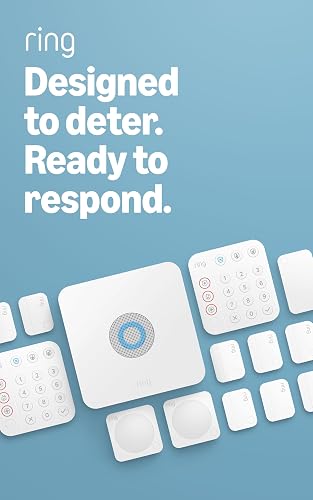
Ring Alarm 14-Piece Kit: Best for whole-house Ring coverage
- 14-piece kit for 2-4 bedroom homes
- Two keypads
- Ring app alerts and control
- Optional professional monitoring
The bigger Ring kit adds a second keypad and more sensors for a two-entry house, all controlled from the same Ring app.
Pros
- Two keypads for two entry points
- Eight contact sensors and two motion detectors
- Alexa voice control with a plan
Cons
- Premium price tier
- Cellular backup needs a subscription
The 14-piece Ring kit suits a 2-4 bedroom house on the Ring app. It adds a second keypad, 8 contact sensors and 2 motion detectors to the 8-piece setup, plus a range extender.
That's double the contact sensors of the smaller kit, which is what a house with several ground-floor windows needs.
Two keypads mean one at the front door and one by the back or the garage, so you're not walking through the house to disarm. The Ring app handles alerts and remote control across the whole system, and the same app shows any Ring cameras you already own.
Like the smaller Ring kit, cellular backup and professional monitoring come with a Ring Protect plan. That's the trade-off: the app control is strong, but the offline path costs monthly.
Without a plan the hub is WiFi-only, same as the fee-free kits.
The sensor count matches a house with several windows and two main doors. If you're already paying for Ring cameras, the second keypad and extra contacts are the main upgrade here.
If you're starting from scratch and want no fees, the tolviviov kit covers more doors for less.
Buy it for a larger home already on Ring. Skip it if you want no monthly fee at all.
Hapippofa GEN 2 Wireless Home Security System: Best for touchscreen control
- Touchscreen hub
- 16-piece kit
- WiFi plus 4G
- 120 dB wired siren
The hub screen shows system status and switches arm modes with a tap, while the app covers remote control and alerts.
Pros
- Touchscreen hub for in-home control
- 16 pieces with 3 motion detectors
- 4G option for call and SMS alerts
Cons
- 4G needs a separate SIM and plan
- Siren is wired, so it needs a cable run
Hapippofa suits a household that wants a screen on the wall. The touchscreen hub shows system status and switches between stay, away, disarm and SOS with a tap, while the app covers remote control and alerts.
The SOS button and two RFID key fobs add ways to arm and call for help without a phone.
The 16-piece kit includes 6 door/window sensors, 3 motion detectors, 2 remotes, 2 RFID key fobs, an SOS button and a 120 dB wired siren. Three motion detectors is the most in this group, so it covers hallways and bedrooms as well as doors.
WiFi handles app control, and a 4G SIM adds call and SMS alerts. Rated range is 100 feet.
The wired siren needs a cable run to its mounting spot, which is more installation work than the wireless sirens on the other kits. The hub also mounts with screws rather than sitting loose.
The 4G SIM and plan are sold separately, and 5GHz WiFi isn't supported.
For a family where some members prefer a panel to a phone, the touchscreen makes daily arming easier. Check that your WiFi is 2.4GHz before you order.
Buy it for touchscreen control at the hub. Skip it if you want an all-wireless install with no cable for the siren.
SimpliSafe 11-Piece System with Camera: Best for camera coverage
- Indoor HD camera included
- Smash-safe keypad
- Base station battery backup
- Optional 24/7 monitoring
The only kit here that ships with an indoor camera, so the app shows you a room as well as alerting you when a sensor trips.
Pros
- Wireless indoor camera in the box
- Base station battery lasts up to 24 hours
- Keypad needs no plug
Cons
- Lowest score in this group
- Network backup needs a monitoring plan
SimpliSafe suits a buyer who wants a camera in the app from day one. The 11-piece kit includes an indoor HD camera with a privacy shutter, a base station, a keypad, 2 motion sensors and 6 entry sensors.
The shutter means you decide when the camera sees the room, which matters in a living space.
The app arms, disarms and shows the camera feed, and the camera's two-way audio lets a monitoring agent speak to an intruder on select plans. The base station battery lasts up to 24 hours.
The motion sensors detect within 35 feet with a 90-degree field of view and are listed as fine with pets under 60lbs. The keypad is smash-safe and needs no plug.
Network backup during an outage requires a monitoring plan. The kit also carries the lowest score here because its app-only alerting without a plan is thinner than the fee-free cellular fallback on the PGST and D1D9 kits.
Its 95 dB siren is also the quietest in this group.
Choose it when seeing the room matters as much as hearing the siren. For plain door-and-window alerts with no subscription, the tolviviov kit costs less over time.
Buy it for camera coverage in the app. Skip it if you want fee-free alerts and no monitoring plan.
How these smartphone-controlled kits compare
The comparison comes down to three things: how the hub reaches the internet, how many sensors come in the box and what the app charges. The table below lines up the specs that decide those answers.
| Product | Best for | Kit size | Connectivity | Siren | Our score |
|---|---|---|---|---|---|
| tolviviov 15-Piece WiFi Home Security System | overall | 15 pieces | 2.4GHz WiFi | 120 dB | 9.5 |
| PGST Home Security Systems 12-Piece Kit | unreliable WiFi | 12 pieces | 2.4G WiFi and 4G | 110 dB | 9.5 |
| D1D9 24pcs Wireless DIY Home Burglar Alarm | large homes and small offices | 24 pieces | 4G and WiFi | 9.2 | |
| TUGARD Alarm System with Phone APP Alert | app alerts without a smartphone habit | 12 pieces | 2.4GHz WiFi and 2G | 9.1 | |
| Ring Alarm 8-Piece Kit (2nd Gen) | Alexa households | 8 pieces | 9.0 | ||
| YISEELE Home Security System Wireless | renters | 5 pieces | 2.4GHz WiFi | 120 dB | 8.8 |
| Ring Alarm 14-Piece Kit | whole-house Ring coverage | 14 pieces | 8.6 | ||
| Hapippofa GEN 2 Wireless Home Security System | touchscreen control | 16 pieces | 2.4GHz WiFi and 4G | 8.4 | |
| SimpliSafe 11-Piece System with Camera | camera coverage | 11 pieces | 7.4 |
Our score weighs specs, features and buyer feedback against what you're shopping for. A kit with 10 door sensors and free app alerts scores higher for most homes than a camera kit that needs a plan for its backup path.
The 2.4GHz-only limit shows up on several kits, so check your router before you order.
Where the fee-free kits win and where Ring and SimpliSafe pull ahead
The fee-free kits carry the sensor counts and the cellular fallbacks. tolviviov, D1D9 and Hapippofa give you more contacts or motion detectors per kit than the Ring boxes at the same tier, and PGST adds 4G without a subscription. That's the value case for a phone-first buyer.
Ring and SimpliSafe pull ahead on app depth and ecosystem. Ring ties the alarm to cameras, doorbells and Alexa in one app.
SimpliSafe puts a camera in the box and lets an agent speak to an intruder. You pay for that depth with a plan when you want cellular backup or monitoring.
Neither ships a fee-free cellular path like PGST or D1D9.
How we compared these DIY home security systems with smartphone control
We compared the kits on the hardware in each box, the app's control and alert features, the hub's backup path and the monthly cost. Sensor counts and siren loudness came from the product data, not from a trial install.
The first cut was connectivity. A kit that only works on 2.4GHz WiFi is fine in most homes, but it goes quiet when the router reboots.
Kits with a 4G path, like PGST, D1D9 and Hapippofa, keep alerting through an outage. Kits with a backup battery in the hub, like YISEELE, keep the siren and local sensors live even when the power is out.
The second cut was coverage per dollar. A 15-piece kit with 10 door sensors covers more of a house than an 8-piece kit with 4, and you feel that difference every time you leave through a side door.
Motion detectors and range figures also went into the score, since a short-range hub in a long house leaves rooms uncovered.
The third cut was the fee. Free app alerts and remote arming are table stakes here, so a kit that charges for cellular backup loses points unless its app integration is strong enough to justify the plan.
Camera kits also got credit for what the extra hardware adds, which is why SimpliSafe still makes the list.
We scored each kit against what a phone-first buyer wants: fast alerts, clear app control and a hub that stays online. If you're weighing a cellular hub against a WiFi-only one in more depth, our guide to WiFi vs cellular alarm systems walks through the trade-offs.
What should you check before buying a phone-controlled kit?
Check the WiFi band first, then the sensor count, then the backup path. Those three decide whether the kit works in your home and whether it keeps alerting when the network fails.
Does the hub support your WiFi band?
Most kits here run on 2.4GHz only. tolviviov, PGST, TUGARD, YISEELE and Hapippofa all say 2.4GHz and not 5GHz. If your router broadcasts both, connect the hub to the 2.4GHz network.
If it's 5GHz-only, add a 2.4GHz access point or choose a kit with a cellular path. The PGST and TUGARD hubs also want the WiFi password free of spaces and special characters, so set up a guest network if yours is complicated.
How many sensors cover your doors?
Count the doors and ground-floor windows you want watched, then match the kit. The tolviviov kit's 10 door sensors fit a typical house.
Ring's 8-piece kit suits 1-2 bedrooms. A renter with one door and two windows can use the YISEELE kit and skip the extra hardware.
Motion detectors are the other half of the count: Hapippofa ships 3 and Ring's 14-piece kit ships 2, while YISEELE ships none.
Do you need alerts when the WiFi is down?
If you travel or your router is unreliable, choose a kit with 4G fallback: PGST, D1D9 or Hapippofa. A WiFi-only hub loses the app link when the network drops, though the local siren still sounds.
Cellular backup on Ring and SimpliSafe requires a paid plan. A hub battery like YISEELE's keeps the system running through a blackout, but the app link still depends on your router having power.
What does the app charge after the first year?
Nothing on the fee-free kits. tolviviov, PGST, D1D9, TUGARD, YISEELE and Hapippofa all provide app control and alerts with no subscription. Ring and SimpliSafe sell optional plans for cellular backup and professional monitoring.
Budget for a SIM data plan on the 4G kits as well. YISEELE's app shows an optional SMS and phone call payment page, and YISEELE says you can close it and keep the free push alerts.
Can you expand the system later?
Yes on most kits. tolviviov takes up to 20 sensors and 5 remotes or keypads. TUGARD supports 100 wireless zones, 10 remotes and 10 RFID cards.
YISEELE supports up to 100 accessories. Ring kits expand with Ring sensors.
Buy the hub with room to grow so you're not replacing it when you add a room. Check the expansion limit against the number of doors you plan to add over the next few years.
How hard is the install?
Every kit here is DIY and wireless, with stick-on sensors for doors and windows. YISEELE puts setup at about 15 minutes and D1D9 at about 30 minutes.
The Hapippofa kit's siren is wired and its hub mounts with screws, so that one needs more work than the rest. Pair sensors one at a time and test each before mounting, so you don't peel and re-stick a contact twice.
Our guide to how to install a home alarm system covers mounting and testing step by step.
Which DIY home security system with smartphone control should you buy?
Most homes should buy the tolviviov 15-Piece WiFi Kit. It covers 10 doors out of the box and sends app alerts with no monthly fee, which is what a phone-first buyer wants from a DIY home security system with smartphone control.
The PGST 12-Piece Kit is the pick when your WiFi isn't reliable, thanks to its 4G fallback. Renters should look at YISEELE for its backup hub battery and quick stick-on install.
Camera-first buyers can choose SimpliSafe for the included indoor camera. If you need the most coverage in one order, D1D9's 24 pieces fit a big house or a small business.
Whichever kit you pick, plan the power side. A hub on battery alone will eventually need fresh cells, and a blackout can take a WiFi hub offline.
Our guide to home alarm system battery backup explains what to expect. If cameras matter more than sensors to you, compare the kits in our roundup of the best DIY home security system with cameras.
Our top 3 picks at a glance
-
1
-
2
-
3
Best for large homes and small offices
D1D9 24pcs Wireless DIY Home Burglar Alarm
9.2/10 our score
See it on Amazon
Frequently asked questions
Will app alerts still arrive if the WiFi goes down?
Only on kits with a cellular path. PGST, D1D9 and Hapippofa can send alerts over 4G when WiFi drops.
Ring and SimpliSafe need a subscription for that.
A WiFi-only hub goes quiet until the router is back.
How many door sensors do I need for a typical house?
Count every door and ground-floor window you want watched. The tolviviov kit includes 10 door sensors and covers most single-family homes.
Smaller kits with 4 or 6 sensors suit apartments or a few main entry points.
Can I add more sensors later?
Yes on most kits here. tolviviov supports up to 20 sensors and 5 remotes or keypads. YISEELE supports up to 100 accessories.
TUGARD supports 100 wireless zones.
Check the hub's limit before you expand.


