9 Best DIY Home Security Systems With No Monthly Fee (November 2026)
The best DIY home security systems with no monthly fee include the PGST Home Security Systems 12-Piece Kit (best overall), the tolviviov 15-Piece WiFi Home Security System for door coverage, and the D1D9 24pcs Wireless DIY Home Burglar Alarm for larger properties.
On this page (10 sections)
- The best DIY home security systems with no monthly fee, ranked
- How these DIY no-monthly-fee systems compare
- How we compared these no-monthly-fee kits
- What should you check before buying a no-monthly-fee kit?
- Which network setup suits your home?
- Do you need a camera in the kit?
- Is a keypad or touchscreen worth it?
- How much expansion do you need?
- Do no-fee kits really avoid all charges?
- Verdict: which no-monthly-fee kit should you buy?
The best DIY home security system with no monthly fee for most homes is the PGST 12-Piece Kit, because it covers a 3-5 bedroom house out of the box and keeps reporting through Wi-Fi or 4G when one connection fails. Pick the tolviviov 15-Piece Kit if you need more door and window coverage, or the YISEELE kit if you rent and want a small hub that survives a blackout.
A no-fee kit changes the math on home security. You pay once for the hardware and then own the alerts, the siren and the app control.
The trade-off is that nobody is watching for you unless you add a monitoring plan later.
This roundup covers self-install kits you can set up in an afternoon without running wire. For the wider category, see our guide to home alarms you can set up yourself.
Our picks at a glance
-
1

-
2
 Best for door coverage
tolviviov 15-Piece WiFi Home Security System
9.5/10 our score
See it on Amazon -
3
 Best for larger properties
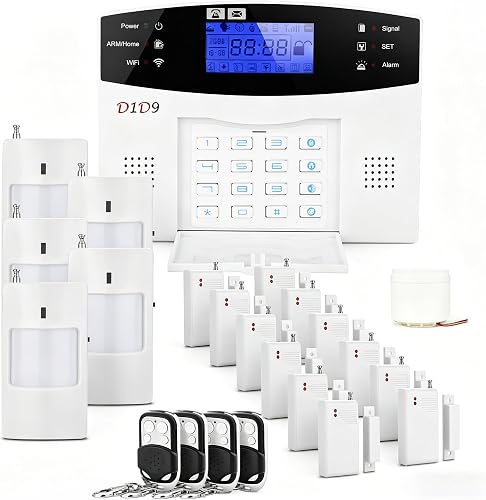
D1D9 24pcs Wireless DIY Home Burglar Alarm
9.2/10 our score
See it on Amazon
- 4
 Check it
YISEELE Home Security System Wireless
Best for renters - 5
 Check it
YBJ Alarm System for Home Security
Best for camera coverage - 6
 Check it
Hapippofa GEN 2 Wireless Home Security System
Best for touchscreen control - 7
 Check it
YBJ Wireless Home Security System
Best for big sensor counts - 8
 Check it
eufy 7-Piece Essential Alarm System
Best for local storage - 9
 Check it
SimpliSafe 11-Piece System with Camera
Best for optional monitoring
The best DIY home security systems with no monthly fee, ranked
The PGST kit is the best fit for a typical house, while the other picks earn their place through door coverage, rental-friendly backup power, camera extras or larger sensor counts. Start with how many entry points you need to watch.
PGST Home Security Systems 12-Piece Kit: Best overall
- Wi-Fi plus 4G failover
- Keypad with stay, away and emergency modes
- Alexa voice control
- Expandable with extra sensors
A balanced starter kit with a keypad, two motion detectors and 4G backup for when home Wi-Fi drops.
Pros
- 4G fallback keeps alerts coming
- Keypad plus app control
- Warranty runs 2 years
Cons
- Fewer door sensors than the tolviviov kit
- Cameras sold separately
PGST suits a 3-5 bedroom house that wants one box to handle the basics. Inside are a base station, a keypad, four door/window sensors, two motion detectors and two remotes, plus the screws and adhesive for mounting.
The keypad sets stay, away and emergency modes without opening the app, which matters when a family member isn't comfortable with phones. The app covers the rest: notifications, device control and Alexa voice commands, all without a subscription.
The 4G fallback is the standout spec. If home Wi-Fi goes down, the system switches to a cellular network so alerts keep arriving.
Cameras are sold separately if you want video, and the kit has fewer door sensors than the tolviviov. For a house with several ground-floor windows, budget for add-ons.
Our guide to the abode security system shows how a camera-plus-sensor setup fits together.
tolviviov 15-Piece WiFi Home Security System: Best for door coverage
- 10 door/window sensors
- 120 dB siren
- Alexa voice control
- Expands to 20 sensors and 5 remotes or keypads
The widest spread of contact sensors in this group, so more doors and windows get watched without buying extras.
Pros
- 10 entry sensors in the box
- Louder siren than the PGST kit
- Room to grow to 20 sensors
Cons
- No 4G backup
- Needs 2.4 GHz Wi-Fi
tolviviov suits a home with many doors and windows to watch. The 15-piece kit packs 10 door sensors, one motion sensor, a keypad and two remotes, which is the most entry coverage in this group before you buy anything extra.
The 120 dB siren is louder than the PGST's 110 dB, and the hub accepts up to 20 sensors and 5 remotes or keypads. That expansion path matters if you start with the front and back doors and add garage or basement contacts later.
One limitation to plan around: the hub only connects to a 2.4 GHz Wi-Fi network. Many modern routers run both bands, so confirm yours broadcasts 2.4 GHz before setup day.
There's no 4G backup here, so alerts stop if your internet does.
Choose it when sensor count matters more than a cellular fallback. Skip it if your home Wi-Fi is unreliable and you want alerts to keep flowing.
Our guide to a DIY alarm system covers how sensors and hubs pair.
D1D9 24pcs Wireless DIY Home Burglar Alarm: Best for larger properties
- 24-piece kit with siren and remotes
- 4G and Wi-Fi connectivity
- Peel-and-stick sensors
- Expandable sensors
A big kit for a house or small business, with enough contacts and a siren to cover several rooms and outbuildings.
Pros
- Most pieces in this roundup
- 4G plus Wi-Fi
- Quick adhesive install
Cons
- Batteries arrive as a gift and may need replacing
- Needs a SIM card for cellular alerts
D1D9 suits a larger house or a small business with more ground to cover. The 24-piece kit includes a siren, a motion detector, two remotes and four door/window contacts, plus a host that runs on 4G and Wi-Fi.
Setup is peel-and-stick and should take about 30 minutes. The 4G plus Wi-Fi pairing means alerts reach the app when your home network drops, as long as a SIM card is installed and active.
Batteries arrive as a gift and may be dead on arrival, so buy spares before install day. The system also targets offices, vacation rentals and elderly care, which fits if you manage more than one property.
Its range is 80 meters, shorter than the PGST kit's 100 meters. In a long house, test sensor placement before you commit to the layout.
Compare this with the best wireless security system no monthly fees options for similar network choices.
YISEELE Home Security System Wireless: Best for renters
- Built-in rechargeable backup battery
- 120 dB siren with SOS remote
- Alexa and Google Home voice control
- Supports up to 100 accessories
A small hub kit that keeps running through a blackout and asks nothing more than a 2.4 GHz Wi-Fi name and password.
Pros
- Works during power cuts
- SOS button on the remote
- 2-year replacement warranty
Cons
- Just 4 door/window sensors
- No motion detector in the box
YISEELE suits renters and apartment dwellers who want protection without touching a lease. The hub runs on a 2.4 GHz Wi-Fi connection and has a 3.7V 500mAh rechargeable backup battery, so it keeps working for hours when the power goes out.
The kit includes four door/window sensors and one remote with a one-touch SOS function. The 120 dB siren and push alerts cover the essentials, and Alexa or Google Home voice control arms and disarms hands-free.
Expansion goes up to 100 accessories, so you can add motion detectors, smoke or water leak sensors, keypads and outdoor sirens as needs change. Installation should take about 15 minutes with adhesive mounting.
The small kit size is the trade-off. Four sensors won't cover a full house, so price in add-ons if you have more than a couple of entry points.
The 2-year replacement warranty is a plus for renters who move often.
YBJ Alarm System for Home Security: Best for camera coverage
- 15-piece kit with an HD Wi-Fi camera
- Wi-Fi plus 4G SIM option
- Auto-dial and SMS to 5 numbers
- Up to 99 sensors
The only pick here that ships with a camera, so you get a picture of what set the alarm without adding hardware.
Pros
- Camera included at no subscription
- Auto-dial and SMS alerts
- Grows to 99 sensors
Cons
- Cellular calls need a SIM card
- Camera coverage only where you mount it
YBJ suits someone who wants a camera in the box without paying for cloud storage. The 15-piece kit includes an HD Wi-Fi camera that pairs with the motion and door/window sensors for a visual check on what tripped the alarm.
Alerts come through the app and through auto-dial and SMS to up to 5 numbers, plus two-way voice so you can talk through the hub. The system handles up to 99 sensors, and scheduled arming means you don't have to remember the nightly routine.
The hub runs on 2.4 GHz Wi-Fi or a 4G SIM card. No subscription is needed for the camera or the core features, though the SIM needs its own data plan if you want cellular alerts.
It ranks below the PGST kit because its single camera only watches one spot. It's the right pick if that camera spot is your front door or main hallway.
Hapippofa GEN 2 Wireless Home Security System: Best for touchscreen control
- Touchscreen hub
- Wi-Fi plus 4G SIM option
- 6 door sensors and 3 motion detectors
- Wired 120 dB siren and SOS button
A 16-piece kit that puts arm, disarm and SOS on a touchscreen, with sensors pre-paired so setup is mostly mounting.
Pros
- Touchscreen hub for the whole family
- RFID fobs and remotes included
- Six door sensors and three motion detectors
Cons
- Wired siren needs a cable run
- 4G calls need a separate SIM plan
Hapippofa suits a household that wants controls everyone can understand. The touchscreen hub shows system status and switches between stay, away, disarm and SOS with a tap, so a visitor or a grandparent doesn't need to learn an app.
The 16 pieces include six door sensors, three motion detectors, two remotes, two RFID key fobs and a wired 120 dB siren. Sensors arrive pre-paired, so setup is mostly mounting and connecting the hub to Wi-Fi or a 4G SIM.
The wired siren is the main trade-off. It needs a cable run to its mounting spot, which is more work than the wireless sirens on most other kits here.
The 4G option also needs a separate SIM plan for calls and texts.
Choose it when a physical panel matters more than a quick install. Skip it for a rental where drilling for the siren cable isn't practical.
Our home alarms guide compares panel-based kits with app-only ones.
YBJ Wireless Home Security System: Best for big sensor counts
- 24 pieces
- Pairs with 100+ sensors
- Wi-Fi plus 4G SIM alerts
- SOS button and remote
A large kit for apartments and offices that expect to keep adding contacts, with room for 100 sensors on one hub.
Pros
- 24 pieces out of the box
- Headroom for 100 sensors
- SOS device for older family members
Cons
- Hub depends on 2.4 GHz Wi-Fi
- No camera included
YBJ's 24-piece kit suits an apartment or office that plans to keep growing. The hub pairs with 100+ sensors, so you can start with what's in the box and add contacts room by room over time.
The kit includes a motion detector, door/window sensor, remote and high-decibel siren, plus a compact SOS device for older family members. Alerts reach the app, the hub and a phone number if a SIM card is installed.
It covers 110 degrees up to 12 meters per motion sensor and uses anti-tamper design. Setup is wireless with double-sided tape or screws, so you can move sensors without patching walls.
The catch is Wi-Fi only at 2.4 GHz for the hub itself. Your phone can be on 5 GHz after pairing, but the hub stays on 2.4 GHz.
It also lacks a camera, so add one if visual confirmation matters. See the abode security system if you want a camera-first brand.
eufy 7-Piece Essential Alarm System: Best for local storage
- HomeBase Mini with 64GB storage
- Keypad, 4 entry sensors and 1 motion sensor
- Step-by-step in-app setup
- Expandable with eufy sensors
A tidy kit with its own storage hub, long-life sensor batteries and a simple app walkthrough for first setup.
Pros
- Local storage on the HomeBase
- Sensors last up to 5 years
- Clear in-app setup
Cons
- One of the smallest kits in this group
- Less coverage than the 12- to 24-piece picks
eufy suits someone who wants a neat, low-maintenance kit with local storage. The 7-piece set includes a HomeBase Mini with 64GB of local storage, a keypad, four entry sensors and one motion sensor.
The big practical win is battery life. eufy says the entry and motion sensors last up to 5 years on one battery, and the keypad is USB rechargeable for about 6 months per charge. That's far less fiddling than the CR2032 swaps on cheaper kits.
Setup is guided step by step in the app: plug in the HomeBase, place the sensors and pair them. The HomeBase also works with selected eufy cameras and doorbells, so you can add video later without a subscription.
The kit is smaller than the 12- to 24-piece options, so a large house will need extra sensors. It's best for an apartment or a small home where four entry points and one motion zone are enough.
Compare it with the best wireless security system no monthly fees picks.
SimpliSafe 11-Piece System with Camera: Best for optional monitoring
- Base station, keypad, camera, 6 entry sensors and 2 motion sensors
- Smash-safe keypad
- Optional professional monitoring with no contract
- Alexa and Google Assistant control
A polished kit you can run without a plan, with the option to add professional monitoring later if you change your mind.
Pros
- No contract on monitoring
- Camera with privacy shutter
- Backup battery in the base station
Cons
- Some monitoring features need a paid plan
- Highest upfront cost tier here
SimpliSafe suits someone who wants the option to add professional monitoring later without a contract. The 11-piece kit has a base station, keypad, wireless indoor camera, six entry sensors and two motion sensors.
The smash-safe keypad arms and disarms from anywhere in the room, and the base station has a 24-hour backup battery plus a 100 dB siren. Alexa and Google Assistant can arm it by voice.
Monitoring is optional and sold without a contract. The camera's live guard feature, where agents see and speak to intruders, needs a monitoring plan.
Running the kit without a plan still gives you app alerts and the siren.
It's the most expensive upfront kit here, and some of its best features sit behind the optional plan. Pick it when you might want a monitored service down the road.
Otherwise the no-fee kits above do more for less.
How these DIY no-monthly-fee systems compare
The PGST kit wins on balance: 12 pieces, a keypad, 4G backup and Alexa, all without a subscription. The tolviviov kit wins on raw door coverage.
The rest trade kit size for backup power, cameras or a touchscreen.
| Product | Best for | Pieces | Siren | Best for | Our score |
|---|---|---|---|---|---|
| PGST Home Security Systems 12-Piece Kit | overall | 12 | 110 dB | 3-5 bedroom homes | 9.5 |
| tolviviov 15-Piece WiFi Home Security System | door coverage | 15 | 120 dB | 9.5 | |
| D1D9 24pcs Wireless DIY Home Burglar Alarm | larger properties | 24 | 9.2 | ||
| YISEELE Home Security System Wireless | renters | 6 | 120 dB | 8.8 | |
| YBJ Alarm System for Home Security | camera coverage | 15 | 120 dB | 8.6 | |
| Hapippofa GEN 2 Wireless Home Security System | touchscreen control | 16 | 8.4 | ||
| YBJ Wireless Home Security System | big sensor counts | 24 | 120 dB | 8.1 | |
| eufy 7-Piece Essential Alarm System | local storage | 7 | 7.7 | ||
| SimpliSafe 11-Piece System with Camera | optional monitoring | 11 | 7.4 |
How we compared these no-monthly-fee kits
Our score weighs specs, features and buyer feedback against what you're shopping for. We checked kit contents, network options, siren loudness, expansion limits and whether the brand sells anything that's actually required to use the alarm.
We favored kits where the core features, alerts, app control and siren, work without a plan. Kits with cellular backup scored higher because they keep working when home internet fails.
Kits with cameras or panels earned points for features that help daily use, not just piece count.
What should you check before buying a no-monthly-fee kit?
Start with how many entry points you need to cover. A kit's piece count tells you less than its split between door sensors and motion detectors.
Four door sensors plus two motion detectors covers a typical 3-bedroom house better than ten sensors that are all door contacts.
How many door and window sensors do you need?
Count every exterior door and every ground-floor window you'd want watched. Add one for a garage side door or a basement window if someone could reach it.
The tolviviov kit's 10 door sensors handle a house with many windows, while the YISEELE kit's four suit an apartment.
Do you need 4G or Wi-Fi only?
Wi-Fi-only kits stop alerting when your router or internet drops. If you travel or your home network is flaky, pay for 4G backup.
The PGST and D1D9 kits switch to cellular automatically, but both need a SIM card and a data plan for that fallback.
Which network setup suits your home?
2.4 GHz Wi-Fi is the safe bet for these kits. Every Wi-Fi hub here needs it, and none support 5 GHz for the hub itself.
Your phone can use 5 GHz once pairing is done.
Wi-Fi only versus Wi-Fi plus 4G
Wi-Fi-only kits are simpler and cheaper. Wi-Fi plus 4G kits cost more but keep sending alerts during an outage.
If you have a security camera or smart doorbell on Wi-Fi already, a Wi-Fi-only kit fits the same network.
What happens in a power cut?
Only kits with a backup battery keep working when the power goes out. YISEELE's hub has a rechargeable backup, and the PGST kit's 4G fallback helps when Wi-Fi drops but not when both power and internet fail.
Check whether a kit's hub has a battery before you rely on it overnight.
Do you need a camera in the kit?
A camera tells you what set the alarm, not just that something did. The YBJ 15-piece kit and the SimpliSafe kit are the two here that ship with one.
Camera kits versus sensor-only kits
Camera kits cost more and only watch one spot. Sensor kits cover more ground for less.
If your front door is the main risk, a camera kit like YBJ makes sense. If you have windows all around, spend the money on more sensors first.
Can you add cameras later?
Yes on most systems here. PGST sells add-on cameras that build a visual monitoring setup with the same app. eufy's HomeBase works with selected eufy cameras and doorbells.
Buying sensors first and video second is a reasonable path.
Is a keypad or touchscreen worth it?
A keypad or touchscreen helps when more than one person uses the alarm. The PGST kit includes a keypad with stay, away and emergency modes.
The Hapippofa kit puts those controls on a touchscreen.
Keypad, touchscreen or app only?
An app-only kit is fine for one tech-comfortable user. A keypad helps guests, cleaners and family members who don't want to open an app.
A touchscreen shows status at a glance. Pick the kit whose controls match the least tech-savvy person in your home.
Where should the panel go?
Mount it near the main entry you use every day, out of reach of a window. If a kit's siren is wired, like Hapippofa's, plan the cable route before you drill.
A wireless siren can sit in a hallway ceiling or another central spot.
How much expansion do you need?
Buy for the house you'll have in two years, not just today. A starter kit you can grow beats a big kit with sensors you never use.
Sensor limits by kit
The PGST kit expands with extra sensors as needed. tolviviov accepts up to 20 sensors and 5 remotes or keypads. YISEELE supports up to 100 accessories.
YBJ's 24-piece kit pairs with 100+ sensors. eufy lets you add entry sensors, motion sensors and eufy accessories through its app.
Which brands let you mix sensors?
Most kits only accept the same brand's sensors. That's the hidden cost of a cheap hub: add-on sensors carry the brand's markup.
If you expect to expand a lot, check the sensor list first. Our home alarms guide lists brands with wider accessory ranges.
Do no-fee kits really avoid all charges?
Yes for the alarm itself. The siren, sensor alerts and app control work without paying anything after the hardware.
Some brands sell optional extras, and those are the only charges you might see.
What might still cost money
SMS and phone-call alerts often need a SIM card with a data or text plan. The Hapippofa and YBJ kits mention this for 4G calls.
Professional monitoring, where a center watches for you, is sold as an optional plan by brands like SimpliSafe.
How to keep the bill at zero
Skip the SIM and monitoring add-ons and use push notifications to your phone. Both PGST and YISEELE push alerts through the app at no charge.
The YISEELE app shows a payment page for optional SMS, but you can close it and keep free push alerts.
Verdict: which no-monthly-fee kit should you buy?
The PGST 12-Piece Kit is the best DIY home security system with no monthly fee for most homes. It covers a 3-5 bedroom house, gives you a keypad for the family and keeps alerts flowing through 4G when Wi-Fi fails.
Choose the tolviviov 15-Piece Kit if door coverage is your priority, or the D1D9 24-piece kit for a larger property. Renters should look at YISEELE for its backup battery, and anyone who wants a camera in the box should pick the YBJ 15-piece kit.
If you might want monitored service later, SimpliSafe leaves that door open without a contract.
For the full field, read our roundup of the best wireless security system no monthly fees, and our guide to home alarms for how the categories fit together.
Our top 3 picks at a glance
-
1
-
2
Best for door coverage
tolviviov 15-Piece WiFi Home Security System
9.5/10 our score
See it on Amazon -
3
Best for larger properties
D1D9 24pcs Wireless DIY Home Burglar Alarm
9.2/10 our score
See it on Amazon
Frequently asked questions
What does no monthly fee mean on a DIY alarm kit?
It means the kit's core features, such as sensor alerts, app control and the siren, work without a subscription. Some brands sell optional extras like SMS alerts or professional monitoring, but the alarm itself keeps working if you skip them.
Do no-fee DIY alarm systems work without internet?
A Wi-Fi-only kit loses app alerts when your internet drops. Kits with 4G or GSM backup, like the PGST and D1D9, keep sending alerts over a cellular network as long as a SIM card has service.
Can I add more sensors to a no-monthly-fee system later?
Yes. Most kits here accept extra sensors, and some hubs handle 100 or more.
Check the brand's sensor list before you buy, because add-on sensors are usually brand-specific.
Is a DIY kit as secure as a professionally installed system?
A DIY kit gives you the same door, window and motion detection without the install fee. What it lacks is a monitoring center watching for you, unless the brand sells that as an optional plan.
How long do the sensors' batteries last?
It varies by kit. eufy says its entry and motion sensors last up to 5 years, while many budget kits use CR2032 or AAA cells you replace yourself. Plan on checking battery levels once or twice a year.
Will a no-fee alarm kit work in a rental?
Yes. These kits mount with adhesive strips or screws, so nothing needs wiring.
If you rent, use adhesive pads and keep the screws so you can patch and reinstall the same sensors in your next place.


